Ask a marketing director whether their attribution is accurate and you will usually get a pause, then a qualified answer. Everyone senses that the numbers do not quite describe how their marketing actually works. Few can articulate exactly why.
The reason is usually simple. Most reporting still runs on last click, and last click answers a question that has very little to do with how buying decisions get made.
Why does last click attribution give a misleading picture?
Last click assigns one hundred percent of the credit for a conversion to the final touchpoint before it. Not most of the credit. All of it. Every earlier touch that created the demand gets nothing, and since budget follows credit, teams defund the channels that generate demand and overfund the ones that harvest it.
Think about how you last bought something considered. A colleague mentioned a tool. You read a comparison article. You saw a case study on LinkedIn. Three weeks later you searched the brand name directly and signed up.
Under last click, that entire sequence is credited to branded search. The colleague, the article, and the case study score zero. Not a small share. Zero.
Now scale that across every conversion in your account. Branded search, retargeting, and direct traffic collect nearly all the credit, because those are the channels people use once they have already decided. The activity that created the decision is invisible.
Harvesting then gets more expensive every year because there is less demand upstream to harvest.
What is last click actually measuring?
It is worth being precise, because last click is not useless. It is just narrow. It measures which channel was present at the moment of conversion, which genuinely tells you something about closing efficiency. The failure is treating a sequence position metric as though it measured contribution.
That is genuinely useful information. It tells you which channels are efficient at closing, which landing pages convert, and where to focus bottom of funnel optimization.
What it cannot tell you is which channels caused the conversion to be possible. It has no view of causation at all, only of sequence position.
Within its own terms it is perfectly accurate. The problem is treating it as though it measured contribution, and then allocating budget on that basis.
Which channels get undervalued by last click?
Four, consistently, across almost every business: content and organic search, paid social, display and video, and email. What they share is that they tend to appear early in a path rather than at the end of it.
Certain channels are structurally penalized by last click, and they are consistent across almost every business.
Content and organic search. Someone reads three articles over a month, then converts through a branded search. The content scored zero. This is why content marketing is perennially difficult to defend in budget conversations despite being the thing that created the branded search in the first place.
Paid social. Rarely the final click for considered purchases, frequently the first exposure. Under last click it looks expensive and ineffective, so it gets cut, and then upper funnel volume declines a quarter later for reasons nobody connects.
Display and video. Even more so, because the interaction is often a view rather than a click.
Email. Effective at reactivation, but the reactivated user often converts through a different final touch.
Meanwhile branded search is systematically overvalued. It shows an outstanding cost per acquisition because it captures demand other channels created. Cut everything else and branded search performance will decline within two quarters, which is the clearest evidence that its numbers were never really its own.
What multi touch attribution models exist, and how do they differ?
Five in common use, and they differ only in the rule they use to split credit: first touch, linear, time decay, position based, and data driven. None is more true than the others.
Multi touch attribution distributes credit across every touchpoint rather than giving it all to one.
First touch credits the earliest interaction. Useful for understanding what creates awareness. Ignores everything that closed the deal.
Linear splits credit evenly across all touchpoints. Naive by design, which makes it a useful neutral baseline.
Time decay weights recent touchpoints more heavily using a half life you choose. Reasonable for short cycles. On a six month cycle with a seven day half life you have effectively rebuilt last click with extra steps.
Position based gives forty percent each to first and last touch, splitting the remaining twenty across the middle. Encodes the common intuition that discovery and closing matter most.
Data driven uses machine learning to assign credit based on observed patterns. GA4 offers this as its default. It is the most sophisticated option and the least transparent, which matters when you need to defend a budget decision.
None of these is correct in an objective sense. They are accounting conventions. The value of running several is that it reveals how much your conclusions depend on which convention you picked.
How do I implement multi touch attribution using GA4 and BigQuery?
Start in GA4, which costs nothing and answers the question roughly, then move to BigQuery when its limits start binding. Those limits bind as soon as you need a longer lookback, a credit rule Google does not offer, or anything joined in from outside the property.
GA4 gives you a starting point at no cost. Under Advertising, then Attribution, you can compare models and change the reporting attribution model for the property. This is worth doing immediately, and it has limits: a fixed set of models, a limited lookback window, and no ability to bring in data from outside GA4.
BigQuery removes those limits. With the GA4 export enabled, you have every session and every conversion at row level, so you can reconstruct full user paths and apply whatever credit rule you want.
The approach is to build a path table: one row per touchpoint per conversion, ordered by time, with the source of each session and the value of the conversion. From that single table you can compute every model.
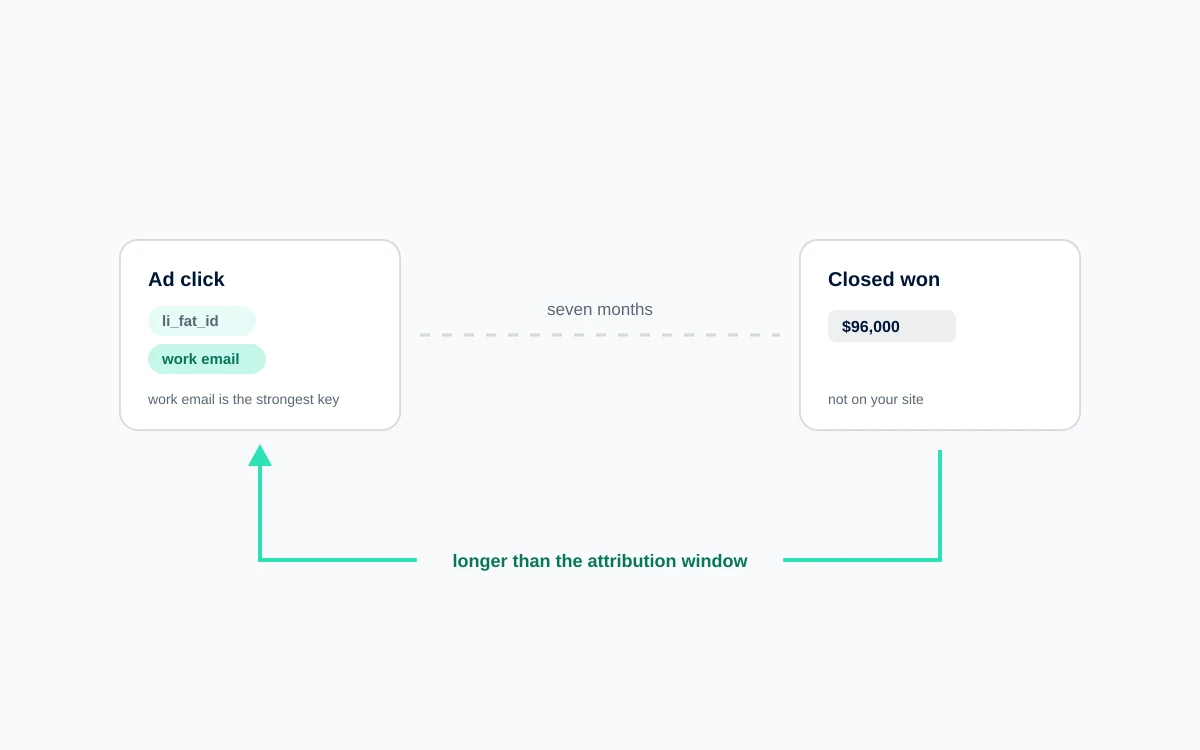
Two decisions need to be explicit and consistent. The lookback window, which should match your sales cycle, and whether direct traffic inherits the previous source or receives its own credit.
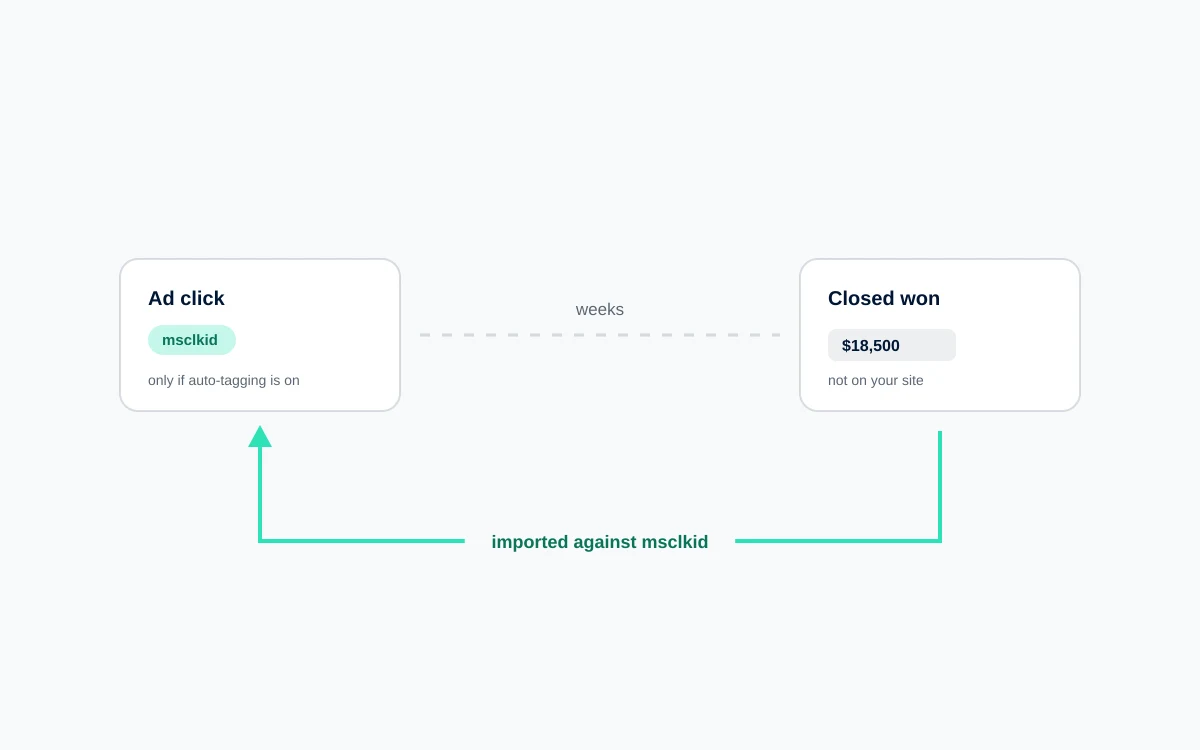
For B2B, the important extension is joining CRM data. Attribution that stops at the form fill still misses the part that matters. Bringing closed deal values into the same analysis lets you credit revenue rather than leads.
How do I use attribution data to make better budget decisions?
Do not look for the model that gives the right answer. Look at where the models disagree. Channels that hold steady across every model are safe to fund. Channels that swing widely are the ones your current reporting is either flattering or burying, and they are where the decisions actually are.
Put every model side by side, channels as rows, models as columns. Then read it.
Channels stable across all models need no further thought. Their contribution is unambiguous.
Channels that swing widely are where your budget has been quietly hostage to a methodological choice. If paid social earns two percent under last click and eighteen percent under linear, then every decision you have made about paid social was really a decision about attribution methodology that nobody discussed.
Compute the ratio of first touch credit to last touch credit for each channel. Above one means the channel starts journeys. Below one means it finishes them. A healthy account needs both, and last click reporting only ever shows you the second kind.
Then shift budget incrementally and watch what happens to total pipeline, not to channel level attributed conversions. Attribution informs the hypothesis. Incrementality testing is what confirms it.
The realistic position
You will not arrive at objective truth about which marketing caused which sale. Nobody does. What you can achieve is a set of consistently applied views that stop one arbitrary convention from governing your spending invisibly.
That is a meaningful improvement over where most teams are, which is running the entire budget on a rule that credits the last click and nothing else.
FAQ
What is multi touch attribution?
Multi touch attribution distributes conversion credit across every touchpoint in a customer journey rather than assigning it all to one. Models include first touch, linear, time decay, position based, and data driven. It exists because most purchases involve several interactions across weeks, and crediting only the final one systematically undervalues the channels that created the demand.
Is last click attribution bad?
Not bad, just narrow. Last click accurately reports which channel was present at conversion, which is useful for bottom of funnel optimization. The problem is treating a sequence position metric as a measure of contribution. Doing so overvalues branded search and retargeting while giving zero credit to the content and social activity that made those final clicks happen.
How do I set up multi touch attribution in GA4?
Open Advertising, then Attribution, then Model comparison to compare models against your existing data. You can also change the reporting attribution model for the property under Admin, then Attribution Settings. GA4's built in models are a good starting point but limited to a fixed set, a capped lookback window, and data GA4 itself holds.
What lookback window should I use for attribution?
Match it to your sales cycle. Thirty days suits most ecommerce, ninety days suits considered purchases, and long B2B cycles need longer still. Longer windows credit more upper funnel activity, so results shift meaningfully with this setting. Always state the window explicitly when presenting attribution results, because it materially changes the conclusions.
Which attribution model is most accurate?
None of them, in the sense of establishing causation. They are accounting conventions applied consistently to observed paths. The productive approach is to run several and examine where they disagree, since channels that swing widely between models are the ones where your budget decisions have been driven by methodology rather than evidence. Confirm with incrementality testing.

 Paid Media